


The Rise of Mobile-First Virtual Tours
The most important trend between 2025 and 2026 is the transition from hardware-heavy solutions to mobile-driven workflows. While platforms like Matterport still dominate high-end 3D scanning, many agents are now prioritizing speed and flexibility over perfect accuracy.Smartphone-based capture has improved dramatically. Modern apps can now:
- Generate floor plans automatically
- Stitch 360° images seamlessly
- Use AI to enhance image quality
- Enable instant publishing and sharing
This means that even solo agents or small agencies can compete with larger firms by producing professional-quality virtual tours without significant upfront investment. As of April 2026, mobile LiDAR scanning and AI stitching have further accelerated this shift, with many agents reporting 30-50% faster workflows.

Matterport Capture App: Premium 3D on Mobile
Matterport remains the benchmark for true 3D digital twins, and its mobile app plays a central role in that ecosystem. Available on both Android and iOS, the Matterport Capture app allows users to scan properties using either a compatible camera or, in some cases, a smartphone.The app is designed to handle complex spatial mapping, enabling features such as accurate measurements, dollhouse views, and detailed floor plans. For luxury listings or commercial properties, this level of detail can significantly enhance buyer confidence. In 2026 reviews, Matterport tours are praised for loading quickly with ultra-smooth panning and transitions, often rated 4.9/5 for quality.
However, real-world user feedback highlights a more nuanced picture. While many professionals rely on the app daily, reviews on Google Play and Reddit indicate ongoing issues with stability, alignment, and device compatibility. Some users report needing to restart scans or deal with crashes during capture, particularly on certain Android devices. Recent updates have improved calibration, but workflow frustrations persist for some.
Despite these challenges, Matterport remains the top choice when precision and visual impact outweigh speed and cost considerations—especially post its acquisition by CoStar, deepening real estate focus.

CloudPano: Mobile-First Workflow for Agents
CloudPano has gained strong traction among real estate professionals because it focuses on ease of use and marketing functionality rather than technical complexity. While it does not have a traditional standalone mobile app in the Play Store, its mobile-optimized web platform functions effectively as a mobile solution. As of 2026, it boasts 73,896+ users, 220,000+ projects, and a 4.9/5 average rating.Agents can capture 360 images using their phones or cameras and upload them directly from the field. What makes CloudPano stand out is its emphasis on client interaction and branding. Features like live video chat allow agents to guide buyers through a property remotely, turning a simple virtual tour into a dynamic sales experience.
User feedback from platforms like G2, Capterra, and its own site consistently highlights the reliability of CloudPano’s mobile workflow. Agents often describe it as their “go-to platform” for creating tours quickly while maintaining a professional appearance. Many praise its white-label options and offline exports.
For many, the key advantage is not just ease of creation but the ability to convert viewers into leads through integrated forms and analytics.

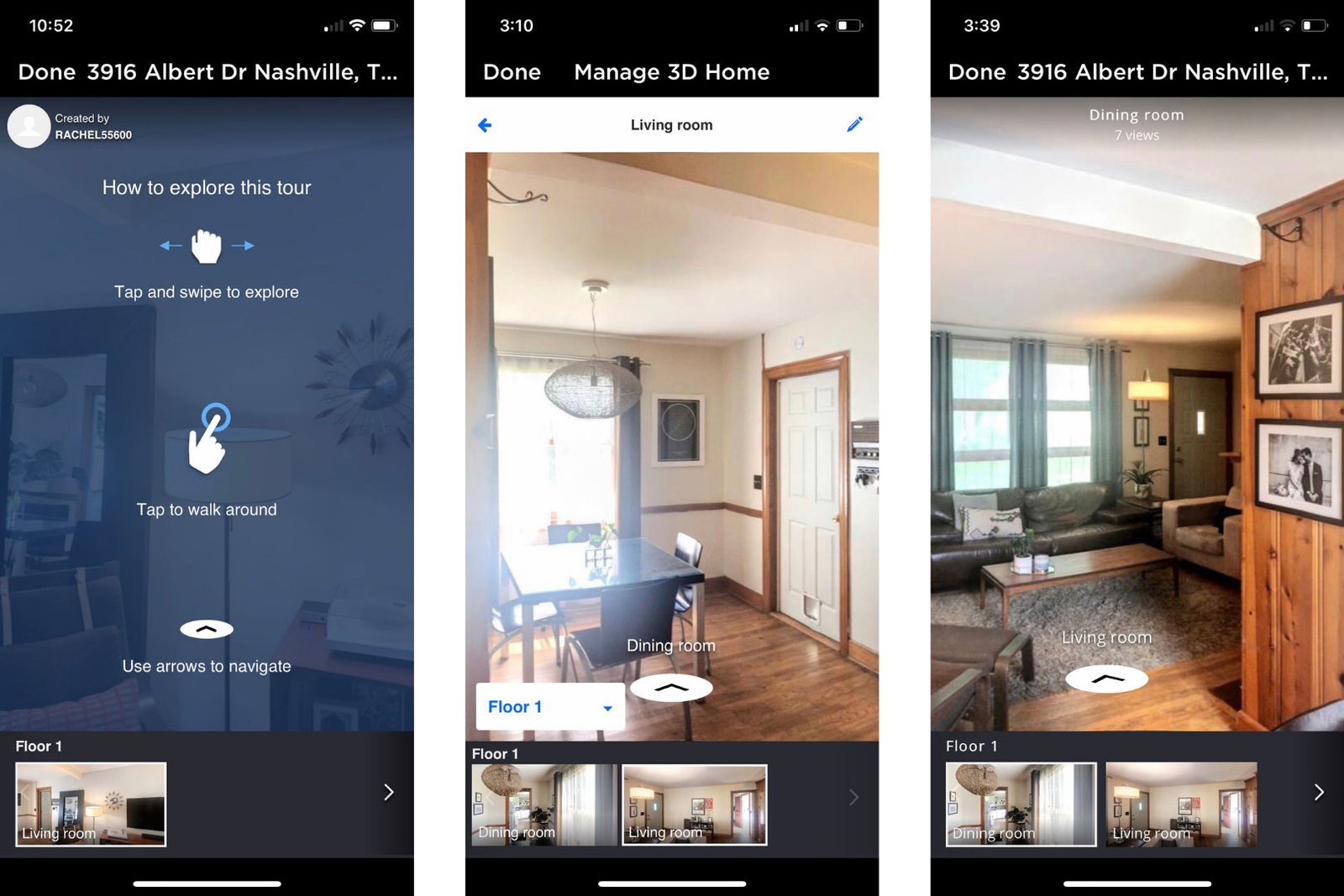
Zillow 3D Home App: Free and Accessible
Zillow 3D Home represents the most accessible entry point into virtual tours. The app is completely free and allows agents to create tours using a smartphone or a compatible 360 camera. Once created, these tours are automatically integrated into Zillow listings, making them immediately visible to a large audience. Recent 2026 updates (e.g., 2026.6.0) improved stability with Insta360 cameras and added modern UI elements.The app’s simplicity is both its strength and its limitation. Many users appreciate how quickly they can produce a tour—often within an hour—without needing specialized skills. This makes it ideal for high-volume listings or agents working with tight budgets.
However, feedback from real estate communities and app reviews reveals some drawbacks. Users often mention issues with connectivity, editing tools, and overall image quality. Compared to premium platforms, Zillow tours can appear less polished, which may impact perception in higher-end markets. It remains practical for visibility boosts.
Even so, its zero cost and seamless integration make it a valuable tool, particularly when used alongside more advanced platforms.
Ricoh360 Tours and THETA Apps: Fast but Frustrating
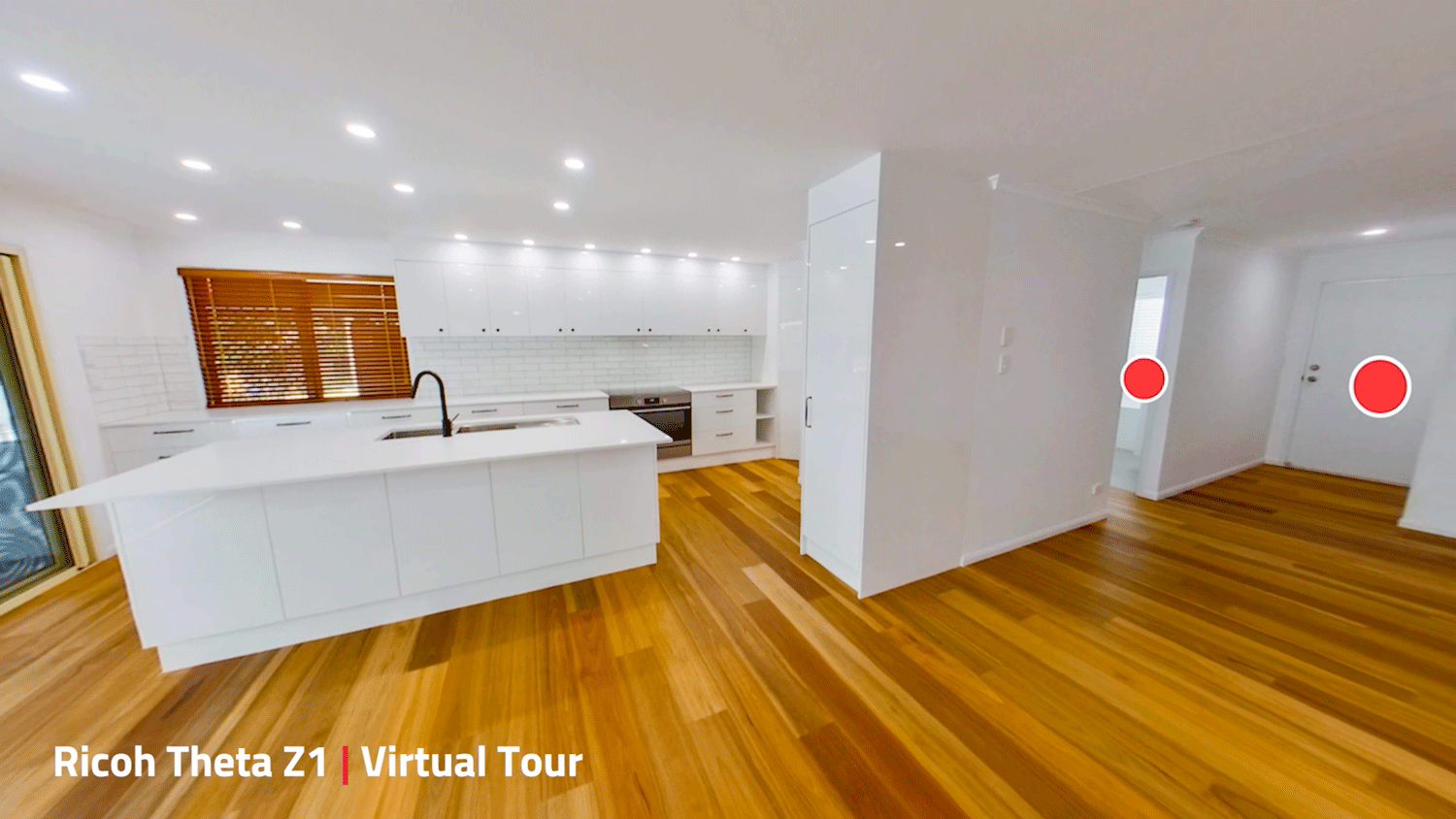
Ricoh’s ecosystem, including Ricoh360 Tours and THETA apps, is widely used by photographers and agents who rely on dedicated 360 cameras. These apps are designed to streamline the process of capturing and uploading panoramic images directly from Ricoh devices like the Theta X.In terms of speed, Ricoh solutions are often praised. Many professionals report that they can create tours significantly faster than with more complex systems like Matterport. This efficiency is especially valuable for agents managing multiple properties. The Theta X excels in high-res stills for tours.
However, user sentiment in 2025–2026 reveals consistent frustrations with connectivity and reliability. Reviews frequently mention difficulties maintaining stable connections between the camera and the app, which can disrupt workflows.
Despite these issues, Ricoh remains popular because of its image quality and compatibility with platforms like CloudPano and Kuula, making it part of a broader, flexible ecosystem.
Insta360 App: A Strong Companion for Modern Workflows
Although not a standalone virtual tour platform, the Insta360 app plays a crucial role in mobile-first workflows. It is widely used in combination with platforms like CloudPano and Kuula, allowing users to capture high-quality 360 images and then upload them to their preferred tour software. Models like the X5 continue to impress in 2026.The app is generally well-regarded for its image quality, ease of use, and stability, particularly compared to some Ricoh alternatives. In online communities such as Reddit and Facebook groups focused on real estate photography, Insta360 cameras and apps are frequently recommended for their balance of performance and affordability.
This reflects a broader trend where agents are combining best-in-class capture tools with flexible software platforms rather than relying on a single ecosystem.

Emerging Mobile-First Innovations
One of the most exciting developments in 2026 is the rise of completely mobile-based 3D solutions. Apps like Polycam and Scaniverse allow users to create 3D scans simply by walking through a property with their phone. These scans can then be converted into interactive experiences using tools like SuperSplat.This approach eliminates the need for subscriptions or specialized hardware, making it highly appealing for agents looking to minimize costs. On platforms like X (Twitter), these tools are often described as “game-changers,” particularly for their ability to create immersive walkthroughs with minimal effort. Polycam now excels in room-scale scans, floor plans, and Gaussian Splatting.
While still evolving, these solutions point toward a future where true 3D capture becomes as simple as recording a video, further lowering the barrier to entry.

Real User Sentiment and Practical Insights
Looking beyond features and pricing, real user feedback from 2026 provides valuable insights into how these platforms perform in the field.
Matterport continues to receive strong praise for its exceptional output quality — with many professionals calling the dollhouse view and smooth 3D walkthroughs “the gold standard” for luxury listings. However, the mobile app still draws criticism for stability issues, including occasional crashes, alignment problems, and Android compatibility challenges. As one Reddit photographer summarized in early 2026: “Amazing output, frustrating workflow.”
CloudPano maintains highly positive sentiment across G2, Capterra, and Facebook groups, consistently earning 4.9/5 ratings. Agents love its reliability, fast mobile-optimized workflow, and marketing tools like live video chat and lead forms. Users frequently say: “It just works — on phone, tablet, or desktop.”
Zillow 3D Home earns appreciation for its free accessibility and quick turnaround, with many agents completing tours in under an hour. Reviews highlight practical benefits for high-volume listings, though image quality and editing tools lag behind premium options. Connectivity issues with cameras remain a common complaint.
Ricoh THETA apps receive mixed feedback — fast capture praised, but connectivity drops and crashes frustrate many users. In contrast, Insta360 apps (especially with the X5) enjoy very strong community support on Reddit and real estate photography groups for superior stability and image quality.
Emerging tools like Polycam and Scaniverse generate genuine excitement among tech-savvy and budget-conscious agents. Users describe phone-only 3D scanning as a “game-changer” for quick, low-cost immersive experiences, though they are still seen as evolving rather than fully replacing established platforms.
This diversity of feedback confirms there is no universal “best” platform — only the best fit for your specific workflow, budget, and property types.
Choosing the Right Platform for Your Needs
Selecting the right virtual tour solution in 2026 depends on your business model, target market, and priorities.
- Luxury or high-value properties requiring precise measurements, dollhouse views, and premium polish → Matterport remains the strongest choice despite occasional app hiccups.
- Speed, flexibility, lead generation, and branding → CloudPano excels here. Its mobile-first design, live chat, white-label options, and proven lead conversion tools make it ideal for scaling operations.
- Limited budgets or high listing volume → Zillow 3D Home offers unbeatable value with seamless MLS/listing integration.
- 360 camera users → Pair Insta360 (for reliability) or Ricoh Theta (for speed) with CloudPano or Kuula for the best results.
- Cost-conscious or experimental agents → Try Polycam or Scaniverse for true smartphone-only 3D scanning and floor plans.
Many successful agents now use hybrid workflows (e.g., Insta360 + CloudPano for most listings, Matterport for premium ones) to maximize both efficiency and impact.
Real User Reviews & Market Sentiment (2025–2026)
Matterport — Still viewed as the premium benchmark on Reddit, Quora, and industry sites. Clients are “immediately impressed,” but creators often note workflow frustrations. Recent updates improved performance, yet stability issues persist for some Android users.
CloudPano — Dominates positive conversations on G2 and Capterra. Agents repeatedly call it their “go-to” for quick, professional, client-engaging tours with minimal technical headaches.
Zillow 3D Home — Practical and widely used, especially for Zillow listings. Praised for simplicity, criticized for lower polish and editing limitations compared to pro tools.
Ricoh THETA & Apps — “Great hardware, inconsistent software” remains the consensus. Fast when it works, but connectivity problems disappoint many.
Insta360 — Highly recommended in real estate photography communities for excellent image quality, app stability, and value. Frequently paired with CloudPano for modern workflows.
Emerging Tools (Polycam, Scaniverse) — Rapidly gaining traction on X, Instagram, and tech forums as affordable, phone-based alternatives. Described as innovative and accessible, particularly for solo agents and smaller teams.
FAQs
Which virtual tour platform has the best mobile app in 2026? Matterport offers the most advanced 3D scanning capabilities on mobile, but CloudPano delivers the smoothest overall experience with fewer technical issues and excellent marketing features.
Can I create real estate virtual tours using only a smartphone? Yes. Zillow 3D Home, Polycam, Scaniverse, and Matterport (on supported devices) enable full tours with just your phone. Adding a 360 camera like Insta360 significantly improves quality.
What is the best mobile-friendly platform for beginners? Zillow 3D Home and CloudPano are the easiest entry points, requiring minimal setup and allowing fast publishing directly from mobile devices.
Are mobile-created virtual tours good enough for luxury listings? For top-tier properties, Matterport or professional hybrid setups are still preferred for accuracy and visual impact. Smartphone-only tours work well for mid-market listings.
Which platform is best for lead generation through virtual tours? CloudPano stands out with built-in lead capture forms, analytics, live video chat, and white-label branding — turning tours into a complete marketing system.
Do I need a 360 camera for professional results? Not essential, but highly recommended. Phones work well for many listings, while cameras like Ricoh Theta or Insta360 X5 deliver noticeably better image quality and faster capture.
What are the biggest problems with mobile virtual tour apps? Common issues include app crashes (Matterport, Ricoh), connectivity failures (Ricoh, Zillow), and limited editing tools (Zillow). Choosing a stable, well-supported workflow is crucial.
What is the future of mobile virtual tours? The industry is heading toward AI-powered 3D reconstruction, phone-based LiDAR/Gaussian Splatting, real-time remote experiences, and fully hybrid mobile workflows. Mobile-first tools will continue to dominate and lower barriers for more agents.
Final Perspective
The virtual tour landscape in 2025–2026 is defined by mobility, flexibility, and rapid innovation. The shift toward smartphone-based creation has democratized access to virtual tours, allowing more agents — including solo practitioners and small agencies — to compete effectively. As of mid-2026, hybrid workflows combining phones, 360 cameras, and AI tools have become the norm, driving higher engagement rates and more qualified leads.
At the same time, platform selection has become more strategic. It is no longer just about creating a tour — it is about how quickly you can produce it, how well it engages potential buyers, and how effectively it converts interest into showings and offers.
For real estate professionals, the smartest approach is to treat these platforms as complementary parts of a broader digital marketing strategy rather than isolated tools. Agents who embrace mobile-first workflows and thoughtfully combine the right technologies will gain a significant competitive edge in today’s fast-moving market.
